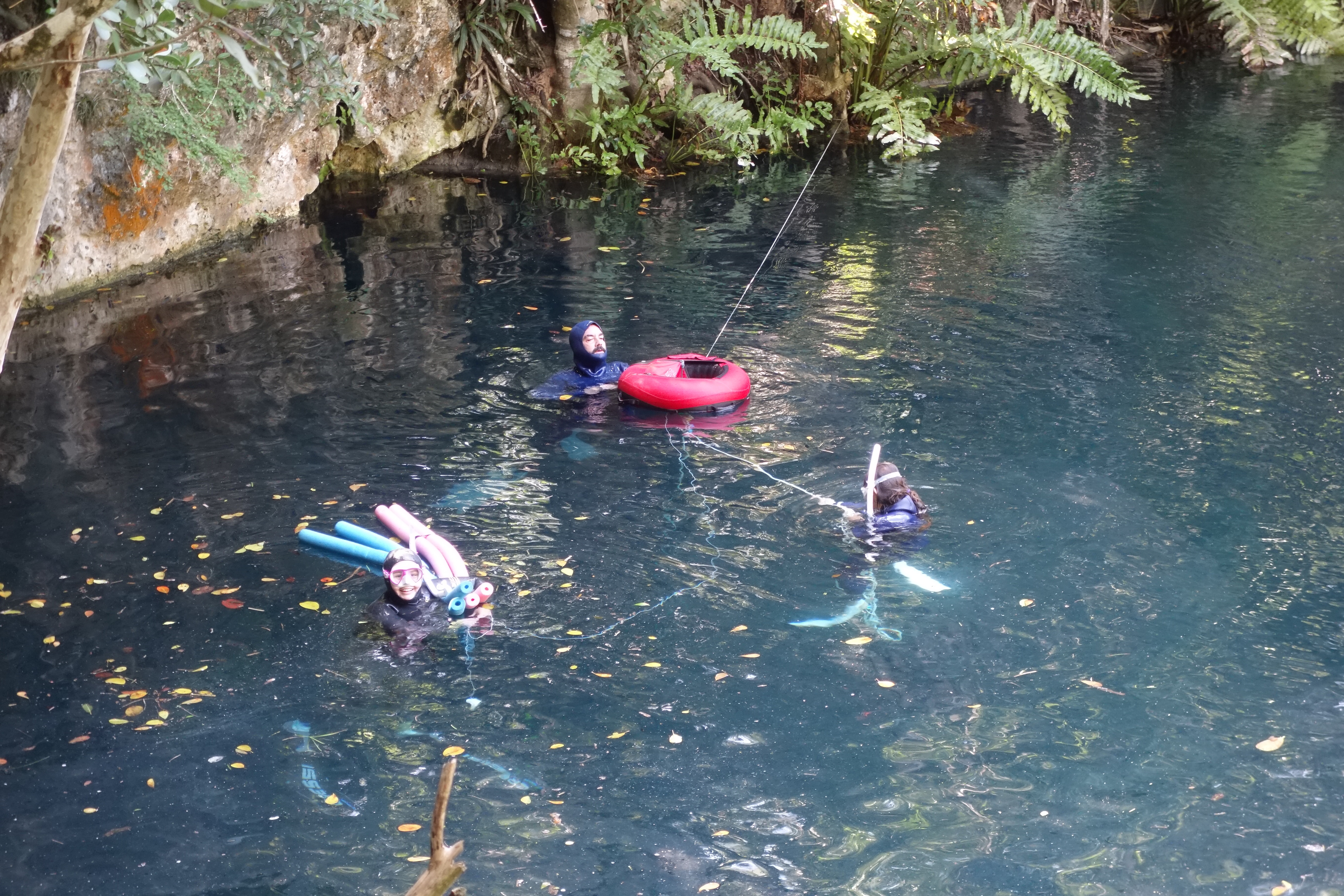
A long overdue article.
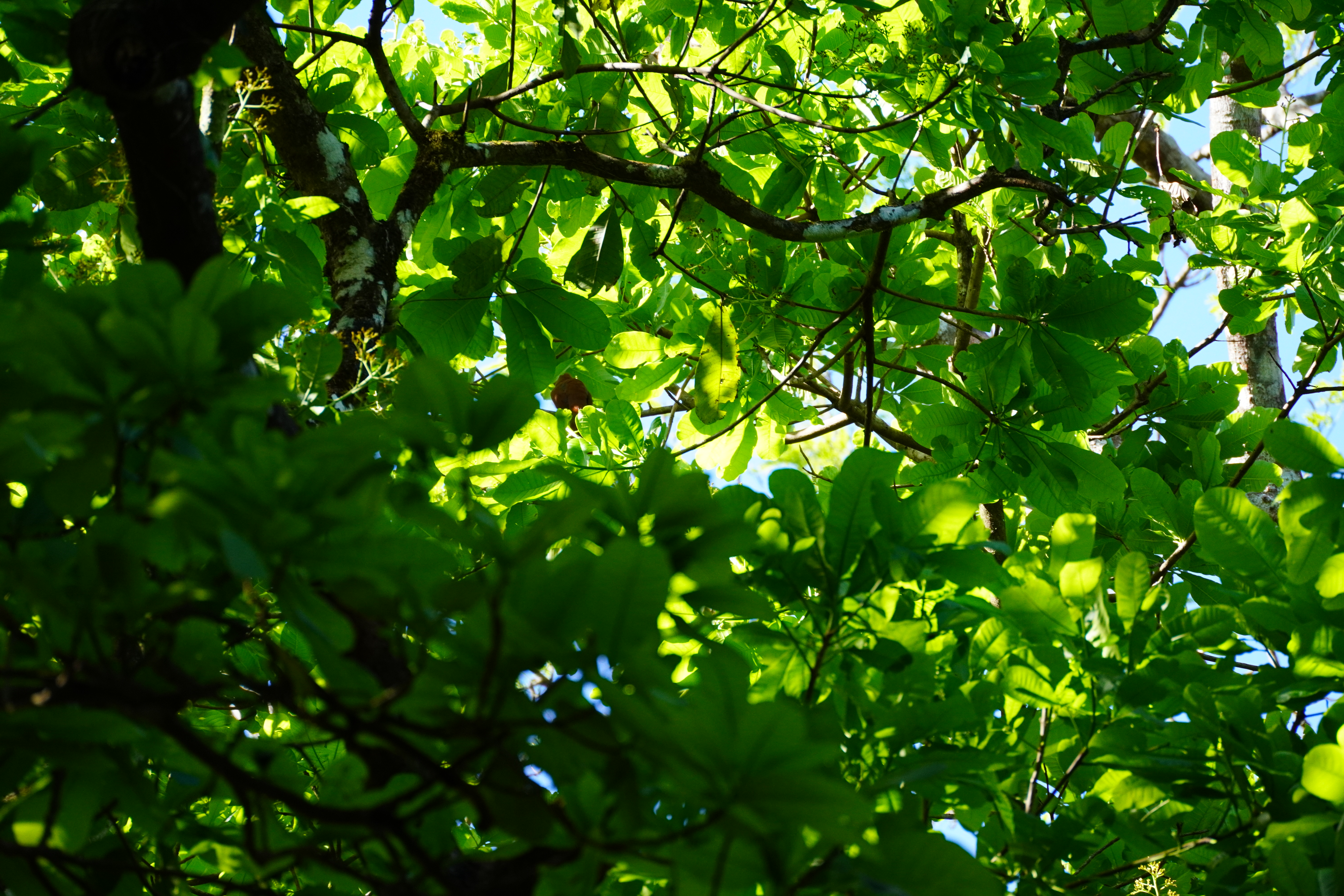
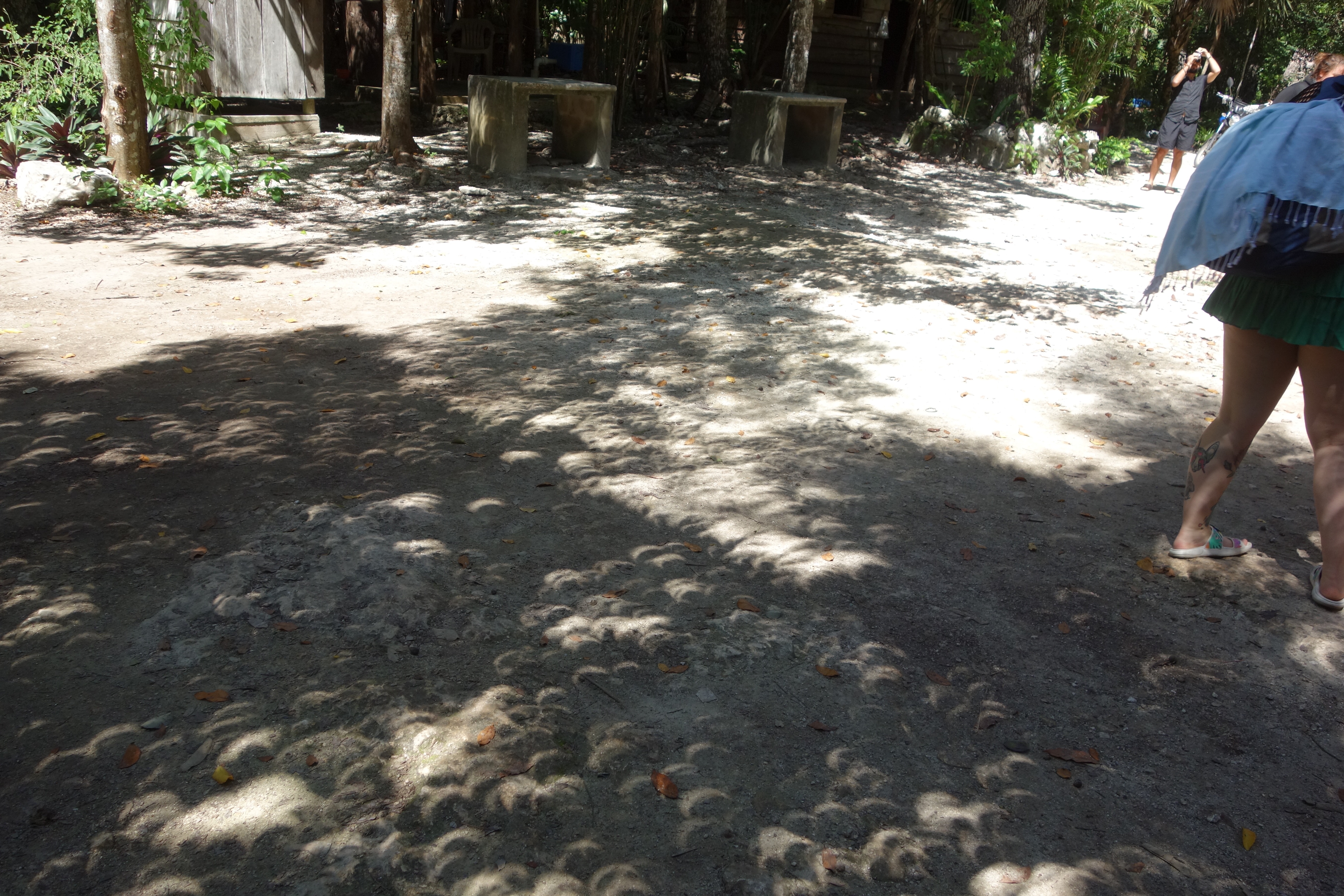
This epic journey started with a solar eclipse. My instructor took me to go buy obsidian stones. You can use these as shields to look at the sun. Shortly after we arrived at the cenote, the moon began to block the sun. This distorted our respective shadows. Check out the crescent shape of the leaves.
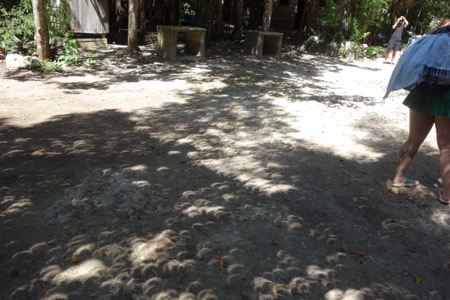
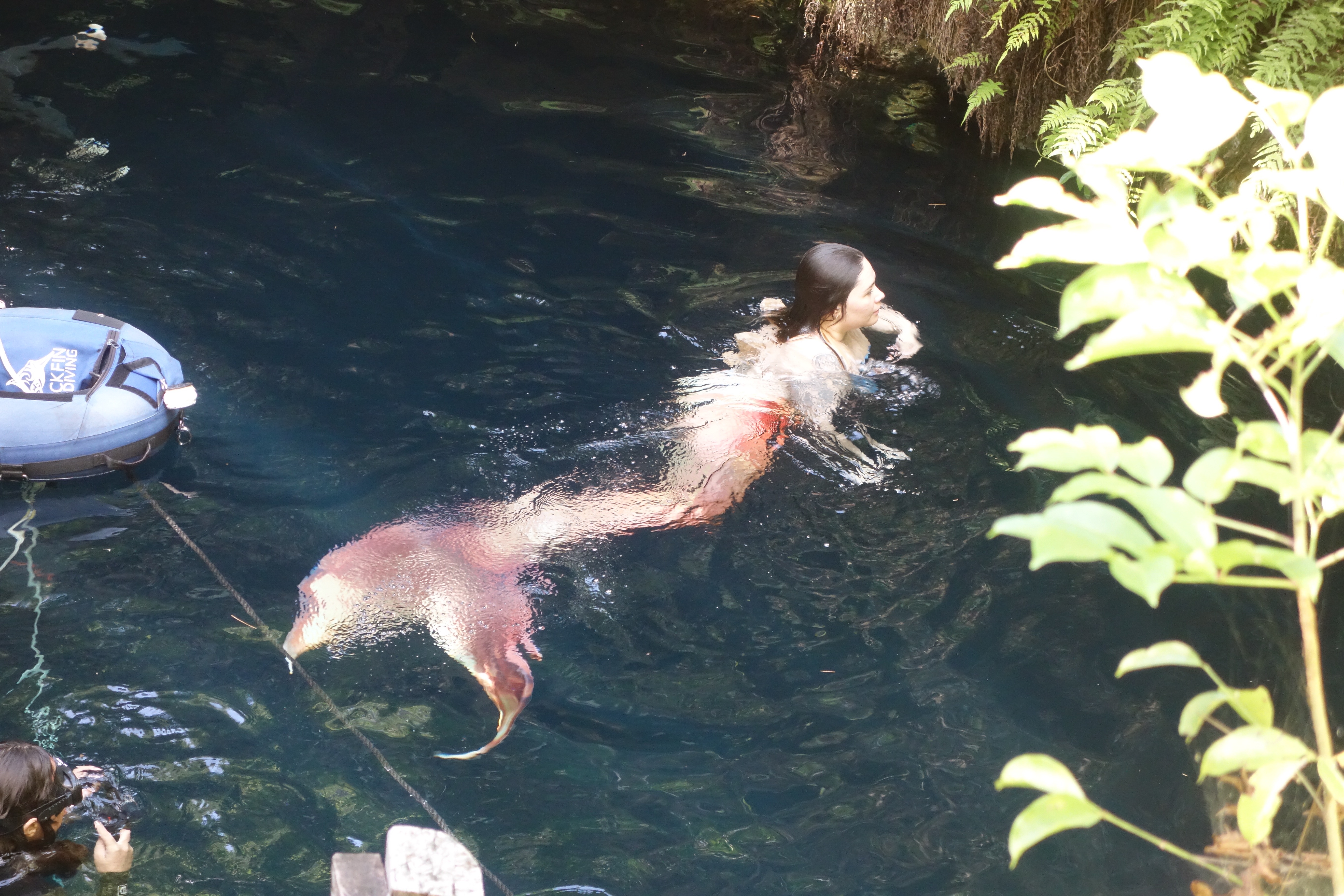
Just after seeing this it was time to get in the water. For the first dives I was tripping out from anxiety. What can I say? Freediving is intense. Some people are naturals; there was a lovely mermaid who was able to get to 25m on her second day. I struggled to get to 15m. One must not compare themselves to mermaids.
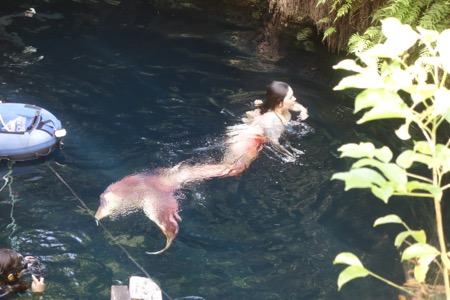
Mermaid mermaiding
When I got home my throat was sore. Something was wrong with my equalization technique. I was using too much effort, which manifested in a horrible noise. I learned from my Instructor that doing this can lead to a trachea squeeze as “shallow” as 20m.
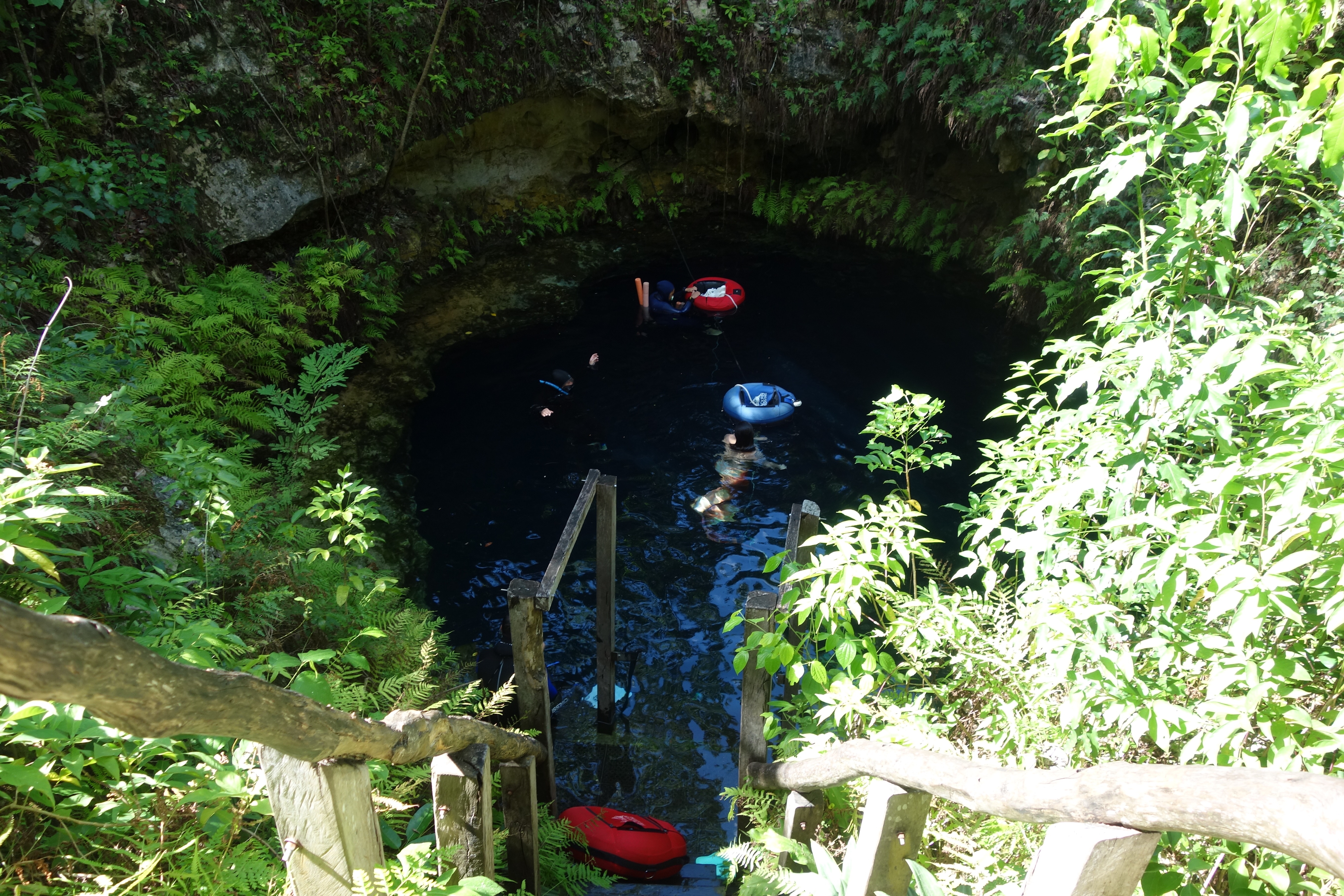
The next day, I went to another famous and beautiful cenote called Angelita. I was hesitant to dive given my sore throat. That said it was feeling a little better, and so I decided to make some conservative dives. My instructor gave me an excellent drill that allowed me to understand what I have been doing wrong with my equalization.
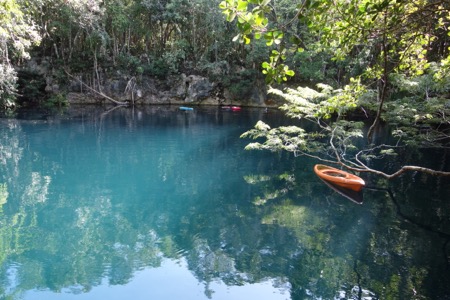
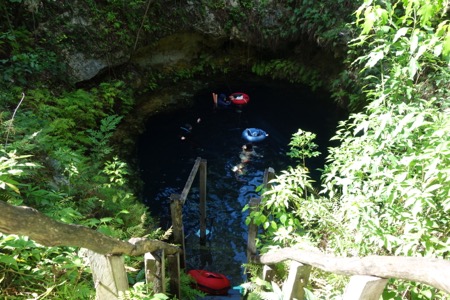
Angelita entrance
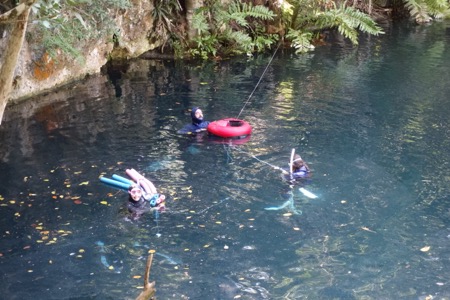
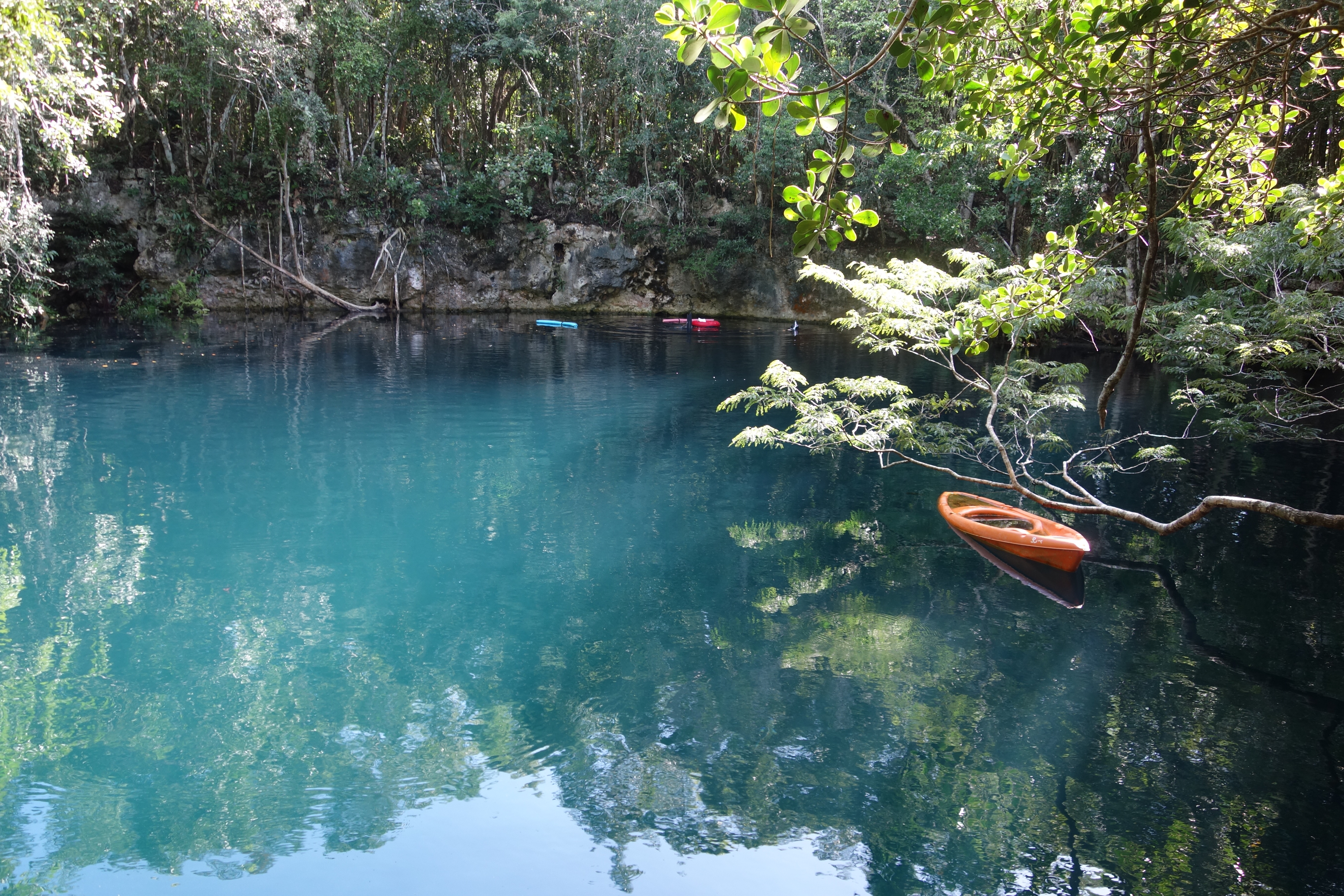
Wrapping up at Angelita
The drill was to fill my mouth with air and dive down and up with my glottis closed. The point of the exercise was to feel my cheeks compressing on the way down and expanding on the way up. I was stunned to see that I was able to make it to about 10m. Normally to get to 10meters I would have to recharge my mouth with air multiple times.
The drill taught me to keep my glottis closed. It became painfully obvious that my problem was that I was constantly opening my glottis, allowing the air in my mouth and nasal cavities to fall back into my lungs. This fault made me have to charge my mouth for every equalization.
My instructor also showed me that I could equalize my mask simply by relaxing my soft palate and unpinching my nose. Previously I had the misconception that I had to actively blow air from my nose into the mask. This misconception arises because you have to create pressure in order to open up the eustachian tubes. It may make one naïvely believe that equalization means pushing air into the middle ear. But once the tubes are open, there is no need for extra pressure. In other words, the pressure is used to open the valve but not to relocate the air once that valve is already open.
After the dive, I got home to rest. My next session was in the pool in the following afternoon. The 30 hours of rest got me worked up about the static apnea challenge. I was spinning thinking about how maybe I would somehow fail to even reach 2 minutes 30 seconds. Or maybe I would try to go for another shot at my PB of 4:40 and then I would black out. In retrospect, it was a silly thing to get worked up over, but my mind tortured me. I calmed myself down by doing 2min 40s static apnea on land.
Still, I was worrying so much about this that I forgot to pack my fins for the pool session. I took full responsibility for it, and it seemed my instructor did as well, so I think we both felt a little bummed out and slightly wishing the other person had not made their respective mistakes. It was not such a big deal, but that meant I would have to come back to the pool to do my 50m horizontal challenge… in any event the static apnea went fine, and I managed to last 3 minutes. At about that time I was dying to pee (a side effect of the mammalian dive reflex) so I was able to excuse myself from not pushing further because I did not want a warm current to brush the leg of my safeties. Lucky me.
The next day I went back to Maravilla, the first cenote. I was feeling confident. Still, I struggled to get to 15m. Even though I knew about my glottis problem, I was still accidentally opening it all the time. Also, my duck dive technique needed serious work. I was starting every dive terribly, causing stress that was fucking up my equalization. In the end, I managed to dive to 20m and see the beautiful cavern of Maravilla. I was high on life.
We were going to the pool that afternoon. During the downtime I managed to get myself into an anxious state. My mind started playing tricks on me, and I started to feel terrible. But it passed, and eventually we were back at the pool.
When we got there, my instructor gave us the drill to swim 200m free stroke and 200m breaststroke. As far as I know, one does not normally warm up for apnea with aerobic training. But I seriously needed to just swim and somehow my instructor knew this so I was so grateful for this warm up.
Then we did safety drills for horizontal apneas. This requires absolute focus. You need to stay right fucking next to your partner, and when they come up for air, you need to immediately tell them to breathe and be ready to catch them if they have an LMC.
While I was safetying, my partner did a turn and grabbed the pool ladder to get extra leverage. I thought this was hysterical. When he came up for air, I was laughing far away from him. My instructor scolded me, I did something incredibly fucking stupid and dangerous by letting the pool-ladder-grab make me laugh and lose focus. Grabbing the ladder might be the exact type of thing someone delirious from lack of oxygen would do.
When it was my turn to do my 50m horizontal distance, I was feeling not great, but not bad either. I did my breathe up and started the apnea. I had horrible technique. Nevertheless, I had my first contraction at around 40m. I think of the first contraction as about the half way point, so I felt confident that I could get to 75m. I sent it. When I came up for air the world seemed fuzzy. I realized that I had to do my hook breaths or I would faint. I recovered and was happy about the accomplishment. But I was stunned at how hypoxic I was.
I realize as I write this where my logic went wrong. When I had my first contraction at 40m I thought “I am halfway through my air and I have swam a pool length and a half, and then some. So certainly another pool length should be no problem.” It’s quite stupid but somehow my brain did not think about the 10 meters I had left to complete my second pool length. So I thought I only had 25m left after completing 50m. But in reality I had 35m left after completing only 40m.
Getting hypoxic when I didn’t expect it shook up my nervous system. I was sad and stressed for the next 24 hours. I still had 3 sessions booked and one more task needed to complete to get my certification, a mock rescue from a black out at 15m depth. I was stressed enough that I was contemplating calling everything off.
At the same time, I saw this as an opportunity to overcome adversity. So I decided to take a three day rest and then get back at it. I contacted the head of Blackfin and asked to push back my Friday session. Then I signed up for William Trubridge’s mental immune system course, and decided to use the time off to get my head in a good place. Learning how to handle myself during stressful times is one of the reasons why I decided to start Freediving.
I found the first few videos of William’s online video course to be helpful. He clearly has thought about the issue of anxiety from both a spiritual and biochemical perspective. There were a couple main takeaways that helped me get into a relaxed state. (1) rhythmic, diaphragmatic breathing.(2) viewing thoughts as an experience like a breeze of wind rather than something tied to one’s identity. The diaphragm breathing sends a signal to the brain that ‘all is good’ ; the dissociation of identity from thoughts takes away the power of intrusive thoughts to cascade into a downward spiral.
Armed with these tools I was feeling better. The head of Blackfin messaged me saying that they were gonna have a fun event and go to a great cenote on Friday and he asked me to change my mind about postponing my next session. I did and had a magnificent time.
We went to a lagoon that was roughly 75 m deep. We had to go to this place because of the caliber of divers that were present. There were national record holders, multiple people who have been deeper than 100m, and otherwise a cool cast of people. Everyone was friendly. The presence of all the talent and the camaraderie gave me a magnificent boost in confidence and relaxation.
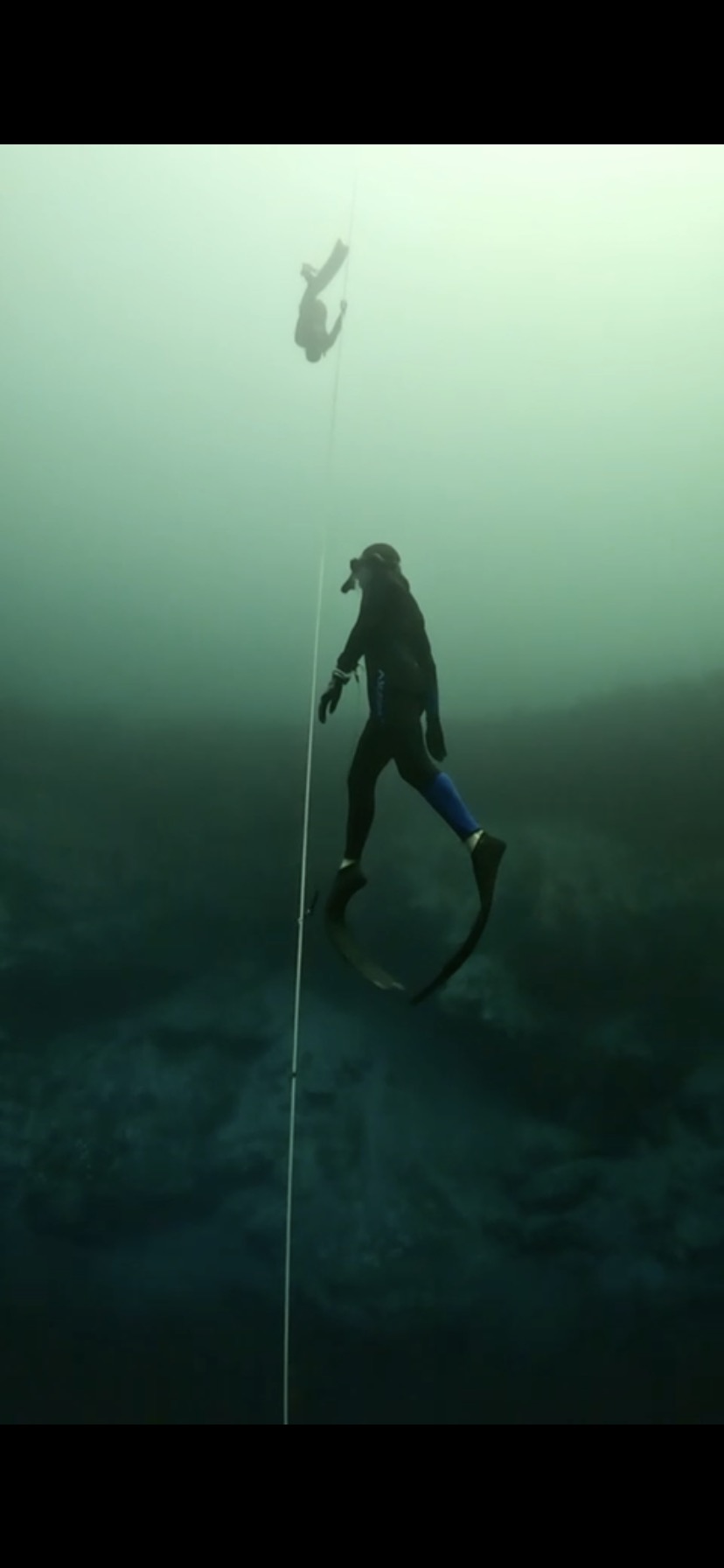
I managed to repeatedly dive to 20m without any equalization problems. The head of Blackfin got some amazing videos, here are some stills. You can see the settlement layer between 0 and 7m. It was such an amazing feeling to break through the cloud and get to see the seawall.
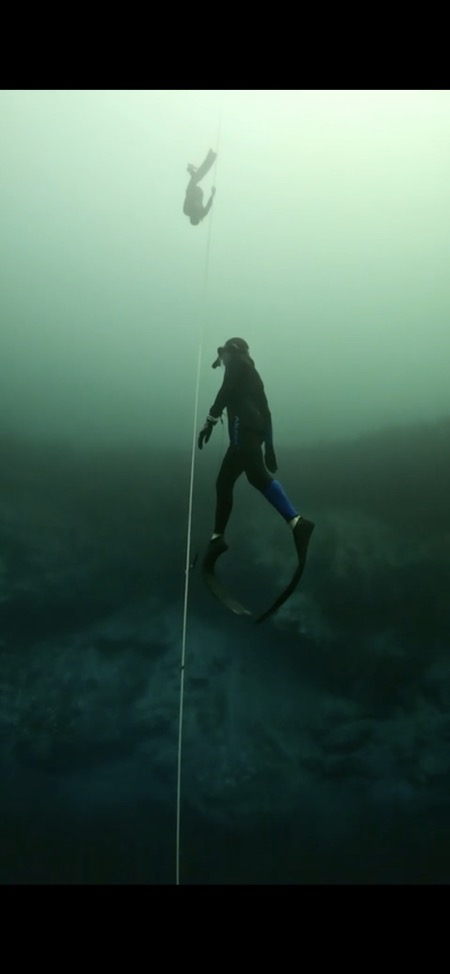
Diving along the seawall of La Laguna de Kaan Luum
The next day I was feeling high on life and went back to Angelita and again was able to dive to 20m without any problems. This cenote has a gorgeous tree coming out of her sulfuric acid cloud. The desire to see this tree in person got me to my happy place before I dived.
I did my 15m rescue and therefore finished the course and got my level two certification.
That was basically the end of the trip with regards to Freediving. I had one more day booked with Blackfin, but the plan was to go to some shallow cenote and have a free swim rather than dive with a line. I was relieved to be done diving, but there was a bitter taste in my mouth. Before coming on the trip I have been to 24.5 m, and I was slightly disappointed that I hadn’t matched or surpassed my PB. I knew my diving had improved, but I didn’t have the depth to show for it.
Well as things turned out, the fun dive got canceled. I had one more shot to go diving on the line and I took the opportunity. I went back to Angelita, the amazing Cenote with a tree coming out of a sulfur cloud.
I was feeling amazing and confident the morning of this last session. We did three warm-up dives to 10m. My equalization was working perfectly. I was ready to do 20m, then maybe 23m, and finally 25m.
Instead, the instructor said I should go to 25m right away while I had the most energy. My heart started racing. I was excited because I was feeling confident that I could do the dive and I knew how great it would be to end on a high note. I started my meditation and got myself to a state of serenity. I envisioned myself in the third person as if I had the perspective of a bird hovering over the Cenote. Then I zoomed out to the perspective of an astronaut in outer space looking down at me. Finally, I zoomed out “ all the way” to another galaxy, and just imagined myself as an infinitely small point. I let the image of Ganesh, the overcomer of obstacles, flash through my head.
The dive was blissful. I performed the equalization exactly as I had planned it in my head. I got to see the beautiful tree and sulfur cloud up close. It was such a beautiful sight that later when I was retelling the story, I started crying.
When I came up from my dive my depth gauge read 25.1m. I was estatic, 25m has a much nicer ring to it then 24.5m. Everyone congratulated me on my personal best. But doing something once shows you have rather than you can. So I repeated the dive and I was later happy to find out that one of the diver friends I had made recorded it with a GoPro.
When I came up from the second 25m dive my instructor told me “you are on the other side.” It’s true, I know how to dive up to 25m and maybe even 30m now. I have a much better understanding of how to perform the necessary equalization, and I have much better control of the muscles necessary to do so.
The excitement of the trip didn’t end there, though. I had one more unwelcomed battle. After our diving session, as we were sitting down for lunch, I started to feel faint. I have neurocardiogenic syncope, which means that my blood pressure can drop dramatically during a fight or flight response, causing me to faint. I started to feel the symptoms of presyncope, and the people who were eating with me told me I turned white as a sheet. I knew there was a chance that I was going to go out and wake up on the floor. But I decided I’m going to fucking fight it and not faint.
The next two minutes were hell. My blood pressure must have dropped to an incredibly low level because I felt my whole arms and hands go numb. I started to use techniques I had learned to calm myself for Freediving. Specifically diaphragmatic breathing and focusing my mental effort on observing the sensations in my body and thoughts in my mind. I also kept drinking water with lime juice and salt as well as a Coca-Cola for sugar. My instructor who was with me helped me with all of this.
For the first time in my life, I endured pre-syncope without fainting. This was a big victory for me in that it taught me that it is possible to stop an episode. But it was maybe a pyrrhic victory because pre-syncope by itself is a fucking horrible feeling that I would very much like to never experience again. And I am concerned about Freediving being a potential trigger for an episode. The problem is that fainting is ultimately caused by lack of oxygen to the brain. This is usually because of low blood pressure, but apneas cause me to feel a similar sensation.
I think that I have developed a fear of the sensation of being close to fainting. This means that after a small amount of hypoxia, my body may start releasing adrenaline, causing the chemical cascade that leads to an episode of syncope. In order to enjoy Freediving, I’m going to have to figure this out. For now it’s time to rest and enjoy the accomplishments of the trip.
Since I wrote this months ago, I've continued to freedive and have achieved 30.9m or 101 ft. That's it for me for now though, I keep dealing with weird fatigue and headaches after diving and I simply cannot enjoy the sport since I always feel bad the day after. So that's it, the story of Will's freediving career and his journey to 30.9m. I'm going to leave my flag there and go find something else to do.